
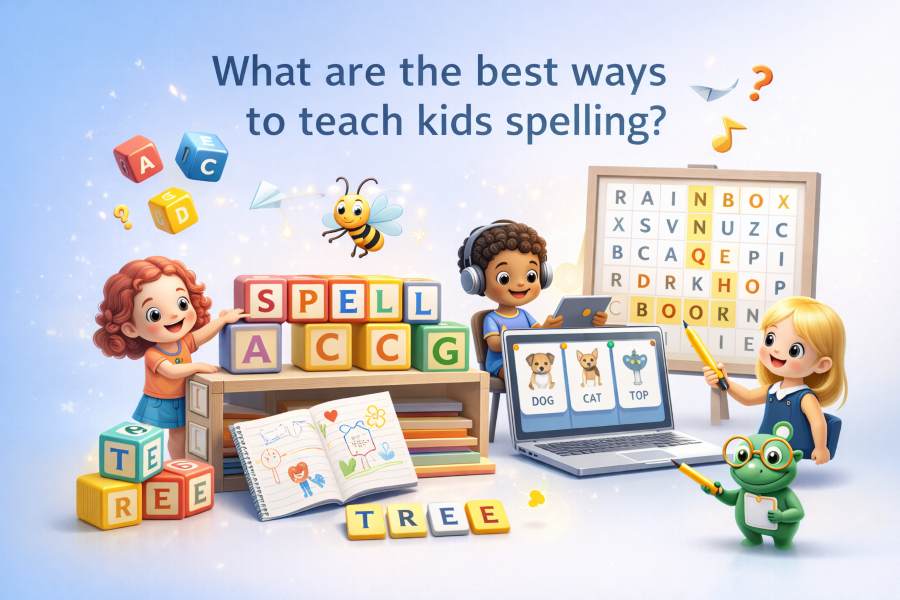
English spelling is notoriously difficult. With its mix of German, Latin, French, and Greek roots, the rules often seem like they were made to be broken. For a child, facing a blank page and a long word can be an intimidating, even tearful experience.
Many parents ask, "What are the best ways to teach kids spelling?" Is it the old-fashioned Friday morning test? Is it writing the word ten times? While these methods are traditional, they are rarely the most effective.
Modern educational psychology favors multi-sensory learning. Kids learn best when they can see, hear, touch, and move with the letters. By turning spelling from a chore into a game of detective work and pattern recognition, you can transform a struggling speller into a confident writer.
English is a "deep" language, meaning sound and spelling don't always match (think rough vs. through). This is why phonics alone isn't enough. Effective teaching must combine phonological awareness (sounds) with morphology (meaning/roots) and visual memory.
Making Spelling Stick: Multi-Sensory Techniques
If a child forgets a word five minutes after the test, they haven't learned it; they've only temporarily stored it. To create long-term memory, we need to engage the senses.
Rainbow Writing
Have the child write the spelling word in pencil. Then, trace over it three times with three different colored crayons or markers. This tactile repetition reinforces the muscle memory of the letter shapes.
Sand & Shaving Cream
Spread sand, salt, or shaving cream on a tray. Have the child spell the word with their finger while saying the letters out loud. This "kinesthetic" approach is brilliant for dyslexic learners.
LEGO® Letters
Write letters on the side of LEGO bricks. Have the child physically "build" the word. This turns an abstract concept into a concrete, 3D object they can hold and manipulate.
Auditory Segmentation
Use "sound buttons" or tap on the table for each sound (phoneme), not just each letter. For "Chat," tap Ch - a - t. This helps kids map the sounds to the letter groups.
The "Look, Cover, Write"
The classic method still works if done right. 1. Look at the word. 2. Cover it. 3. Visualize it in your "mind's eye." 4. Write it. 5. Check it. The visualization step is key.
Word Surgery
Write a complex word on a strip of paper and use scissors to cut it into syllables or morphemes (meaningful parts). Example: Un-help-ful. Then, ask the child to tape it back together.
Game-Based Learning: The "Stealth" Approach
When learning feels like play, resistance disappears. Games reduce the anxiety associated with making mistakes, allowing the brain to take risks and learn faster.
- Scrabble & Bananagrams: These classic games force kids to look at the available letters and construct possibilities. They teach flexibility and vocabulary simultaneously.
- Spelling Battleship: Create a grid where ships are hidden. To make a "hit," the child must correctly spell the word associated with that coordinate (e.g., A4 is "Because").
- Word Hunts: Instead of a list, give the child a highlighter and a page from a magazine. Ask them to find and highlight all the words with a specific pattern (e.g., "Find all the words ending in -ing").
Common Pitfalls: What Parents Should Avoid
Even with the best intentions, we can accidentally hinder a child's progress. Here are the traps to watch out for when teaching spelling.
The "Write 10 Times" Myth
The Mistake: Thinking repetition equals learning.
The Reality: Kids often switch to "autopilot," copying the letters without thinking about the sounds. They are drawing, not spelling.
Focusing on Neatness
The Mistake: Criticizing handwriting during spelling practice.
The Reality: This overloads the brain. Separate handwriting practice from spelling practice. Let spelling be messy if the letters are correct.
Over-Correcting
The Mistake: Fixing every single mistake in a creative story.
The Reality: This kills the desire to write. Focus on the "Target Words" for the week, and let the rest slide until the editing phase.
Ignoring Dialect
The Mistake: Assuming "pure" pronunciation.
The Reality: Accents change how we spell. If you say "warter" for "water," acknowledge it. Teach the child the "spelling voice" vs. the "speaking voice."
Random Lists
The Mistake: Lists like: Apple, Boat, Cat, Dog.
The Reality: Group words by pattern. Teach "Boat, Coat, Goat, Float" together. The brain loves patterns and learns them 10x faster.
Rushing the Basics
The Mistake: Moving to long words before mastering short vowels.
The Reality: If a child can't spell "cat" or "sit" instantly, they will crumble under "vacation." Build the foundation first.
Conclusion: Patience and Pattern Recognition
Teaching kids spelling is a marathon, not a sprint. It requires patience, humor, and a willingness to get messy with letters. Remember that every child's brain is wired differently; what works for one sibling might not work for another.
Focus on progress, not perfection. Celebrate the logic behind their mistakes (e.g., spelling "phone" as "fone" shows they understand the sounds!). By using multi-sensory methods and keeping the atmosphere light, you aren't just teaching them to spell; you are teaching them to love words.
Parent Q&A Corner
At what age should spelling instruction begin?
Formal spelling lists usually start around age 6 (1st Grade). However, "pre-spelling" skills like rhyming, recognizing letters, and playing with sounds should start as early as age 3 or 4.
What about "Invented Spelling"? Is it bad?
No! Invented spelling (e.g., writing "iz" for "is") is a crucial developmental stage. It shows the child is actively listening to sounds. Support it in the early years, then gradually guide them to standard spelling.
My child spells fine on tests but forgets later. Why?
This is a sign of rote memorization (short-term memory). Switch to phonics-based rules and morphology (roots). They need to understand why the word is spelled that way to retain it long-term.
How can I help a dyslexic child with spelling?
Dyslexic learners thrive with explicit, structured phonics (like Orton-Gillingham). They need multi-sensory methods—touching letters, color-coding sounds, and avoiding visual clutter.
Should we use spelling apps?
Apps like Spelling City or Duolingo ABC are great supplements because they provide instant feedback and gamification. However, they should not replace physical writing and reading.